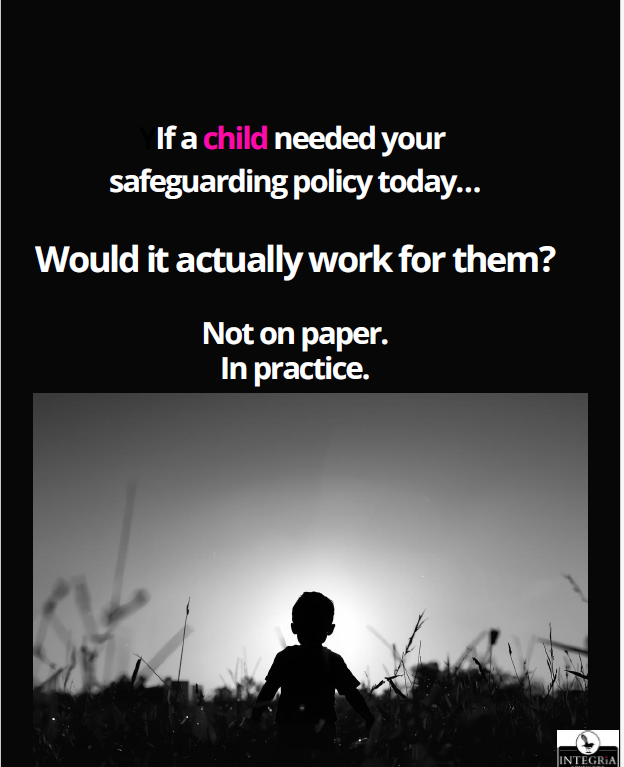
Would your safeguarding policy work in practice?
If a child needed to rely on your safeguarding policy today, would it actually work for them?
Not on paper.
In practice.
Most leaders I work with care deeply about safeguarding.
But many quietly carry a question they don’t always say out loud:
How confident can we really be about what is happening in everyday practice across the organisation?
From the leadership table, practice is often harder to see than we assume.
Over time I’ve noticed that when safeguarding issues emerge, they rarely appear suddenly.
They usually sit behind patterns that have been present for a while.
Things like:
Policy confidence, limited practice visibility
Leaders feel confident policies are strong, but have limited visibility of how safeguarding actually works day to day.
Safeguarding attention drift
After an incident, review or audit, safeguarding receives strong attention. Over time operational pressure takes over and attention moves elsewhere.
Voice without response
Staff or families raise concerns, but systems don’t always respond in ways that build confidence that speaking up matters.
Diffused accountability
Everyone agrees safeguarding matters, but it’s not always clear who is responsible for ensuring it’s working in practice.
None of these patterns mean organisations don’t care about safety.
But they do signal where leadership attention matters most.
Because safeguarding culture isn’t created by policy alone.
It’s shaped by what leaders notice, ask about, and keep visible over time.
For leadership teams, the real question becomes simpler than we think.
If a safeguarding concern arose tomorrow, would your systems actually work the way you believe they would?
Not on paper.
In practice.
It’s a question many leadership teams are beginning to ask more deliberately.